What changes past 2,000 kilometres
A box that makes it to Vienna without trouble can come apart on the way to Madrid. It is not luck. Three differences add up:
- Time under vibration. Two days of continuous shaking does what six hours does not get round to — the contents settle, the edges wear, the tape lets go.
- Transshipment. Long routes more often go as part loads, where the goods are transferred once or twice. Every extra handling is another opportunity for damage.
- Temperature. The vehicle sits in the sun for two days and cools down at night. Condensation is real, and cardboard absorbs moisture and loses its strength.
Boxes: smaller, fuller, double-wall
Three rules that solve most of the problem.
Small boxes for heavy things. Books and tools go in small boxes, up to 20 kilograms. A large box full of books gives way at the bottom — not immediately, but on the third day.
No box may be half empty. Empty space means the contents move for two days. Fill it with towels, bedding, crumpled paper. Close the box, shake it, and you should hear nothing.
Double-wall cardboard for anything fragile. Single-wall is fine for clothes, but not for crockery travelling 2,000 kilometres. We deliver the materials the day before the move, so nothing is bought in a hurry.
Planning a move?
Tell us what needs moving and we will give you a firm price.
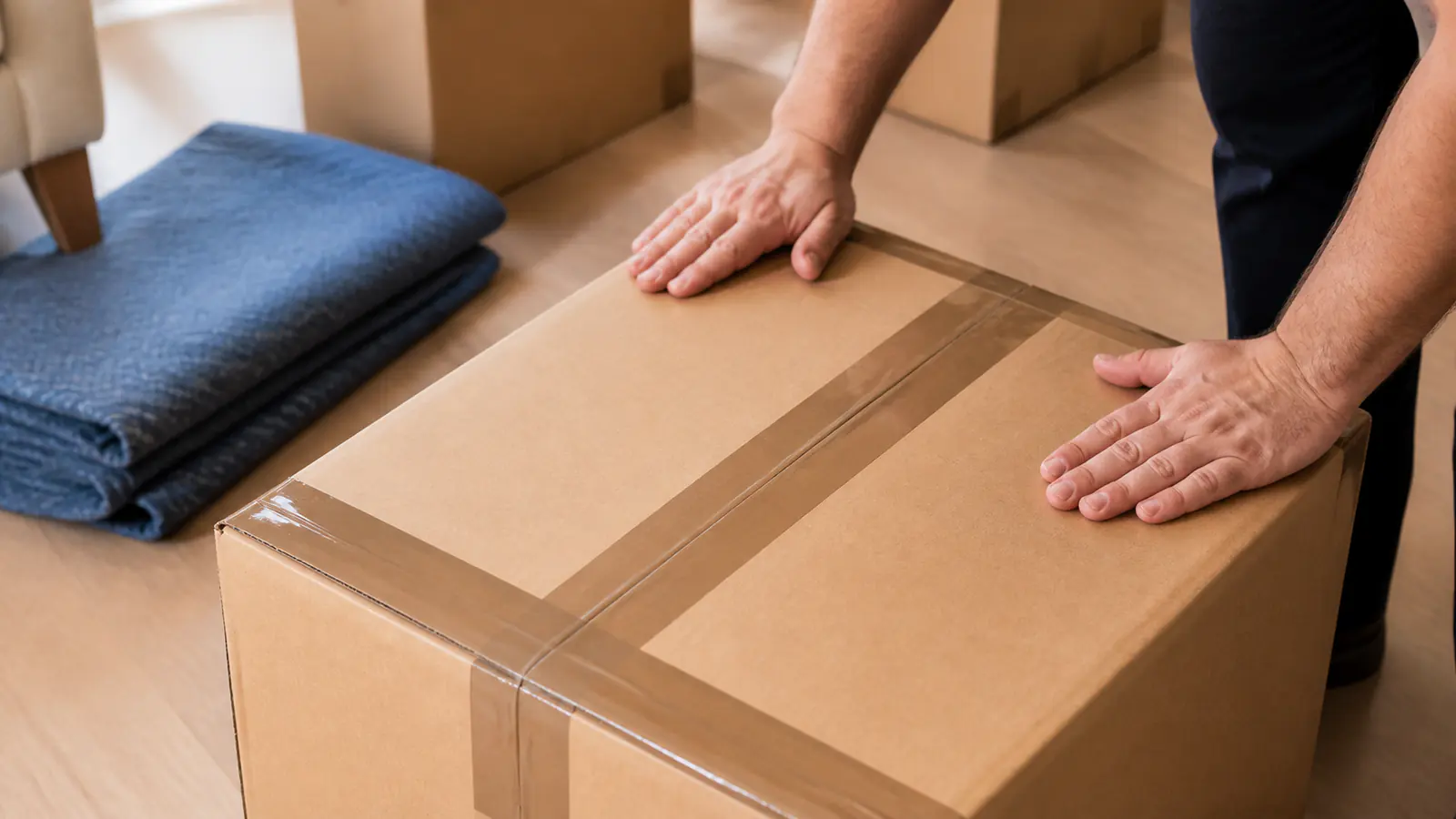
Tape the base in an H, not a single strip
Small detail, biggest difference in outcome. The base of the box is taped so that the tape runs along the central seam and across both end edges — the shape of the letter H.
One strip across the middle holds while you carry the box around the flat. It does not hold after two days of vibration, because the force goes to the corners, and the corners are not taped.
For heavy boxes: two layers of tape on the base, applied at the time, not after it starts to give.
Furniture: dismantle it and wrap it
On short routes furniture often travels assembled, in blankets. Over 2,000 km that is not enough.
- Dismantle everything that comes apart — table legs, shelves, beds. An assembled piece has leverage, and under vibration it unscrews itself.
- Screws in a bag, taped to the piece they came from — not in one communal box.
- Protect the corners separately, with card corner pieces or several layers of film. Corners are the first thing to suffer during transshipment, which is why for valuable pieces dismantling with professional packing pays for itself.
- Glass and mirrors upright, never flat. Laid flat, glass cracks from vibration; standing up it is far more resistant.
- Drawers empty and fixed. A full wardrobe is a weight that drags the whole piece under braking.
Labelling that actually helps
On a long route your boxes pass through more hands than on a short one, so labelling is not cosmetic.
- Write on the side, not the lid — boxes get stacked and the lid is not visible.
- On every box: the room at the new address and a sequential number.
- FRAGILE on all four sides, not one.
- A THIS WAY UP arrow on anything that must not be inverted.
The sequential number ties the box to the inventory list, and that list is both a customs document and your evidence if something is damaged — the detail is in insuring your goods in transit. One list, three purposes. Prices by country are on the international moving page.
What should not go in the truck
On a two-day journey this matters more than on a six-hour one. Documents, the medication you take daily, chargers, keys and jewellery travel with you. The shipment can arrive a day or two after you do, and insurance as a rule does not cover cash or valuables.
Separately, there is a list of things that cannot cross the border at all — that is covered in what cannot cross the border.
If the packing looks like more work than you want, we do it as a service. You can see the price for your own route through the calculator.
Frequently asked questions
Why must boxes not be half empty?
Because the contents move for two days under vibration. Fill the empty space with towels or bedding — close the box, shake it, and you should hear nothing at all.
How should the base of a box be taped?
The tape runs along the central seam and across both end edges, in the shape of an H. A single strip across the middle holds while you carry the box around the flat, but not after two days of vibration, because the force goes to the untaped corners.
How heavy can one box be?
Up to 20 kilograms. Books and tools go in small boxes — a large box full of books gives way at the bottom, usually not at once but on the third day of the journey.
How are glass and mirrors transported?
Upright, never flat. Laid flat, glass cracks from vibration; standing up it is far more resistant. The corners get extra protection with card corner pieces.
Where should the labels go on a box?
On the side, because boxes are stacked and the lid cannot be seen. Each one gets the room at the new address and a sequential number, with FRAGILE on all four sides.
What should not be packed in the truck?
Documents, daily medication, chargers, keys and jewellery travel with you. The shipment can arrive a day or two after you do, and insurance as a rule does not cover cash or valuables.

Marko Mišulić
KOMBI-KOMBI has been running since 2013, and in that time several thousand homes and businesses have gone through our vans in Belgrade, across Serbia and around Europe. Everything on this blog comes from what our crews actually meet on the job.