Five rules that decide whether anything breaks
1. Start two days early. Packing crystal, porcelain and glass is not work that tolerates haste. If you are not having us pack, begin at least two days before the move, and decide as you go what travels in the van and what travels in your own car.
2. Buy the right materials first. Boxes in several sizes, packing paper, bubble wrap, stretch film, corrugated card, scissors and tape. A large table to work on makes more difference than people expect. We deliver the materials the day before if you order them with the move.
3. Mark the fragile boxes. A box clearly marked FRAGILE with an arrow for which way is up tells the crew everything they need before they touch it — at loading and again at unpacking.
4. Pack each thing the way that thing needs. A flat-screen television and your grandmother's porcelain are both fragile and have almost nothing else in common. Work it out per item rather than per box.
5. Do not overfill — and watch the weight. An overfilled box presses on its contents; an underfilled one lets them slide and knock together on the road. Leave a couple of centimetres at the top for crumpled paper, and shake the box before you tape it: if anything slides or rattles, add more filling. Keep fragile boxes under about 15 kg even if there is room left — heavier boxes are harder on the stairs, and more likely to be picked up carelessly.
Item by item
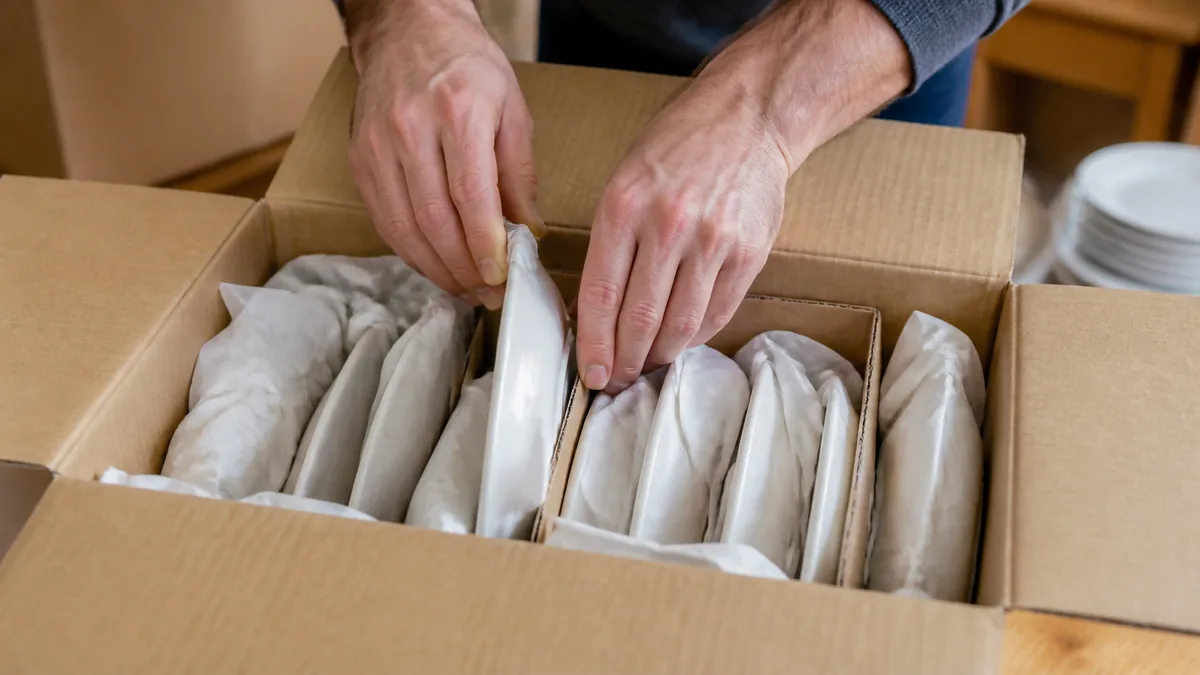
Plates. On edge, like records, never stacked flat — in small or medium boxes lined with crumpled paper top and bottom. Wrap each plate and put paper between them. Plates survive on edge and break stacked.
Glasses. Wrapped individually, with large pieces of crumpled paper filling the gaps. Line the box well top and bottom, paper between the layers, heaviest at the bottom and lighter on top.
Pictures and framed work. Individually, with card corners on every corner — that way the frame cannot be dented even if the box takes a knock. Small or medium boxes, paper between each piece.
Lamps. Separately, with plenty of paper. Shades go in their own box; bases are wrapped in bubble wrap.
Televisions and monitors. Remove the cables and the stand and pack those in a clearly labelled box of their own. Wrap the screen in a soft blanket taped around the set, then into a box of the right size. The original box, if you kept it, beats anything else.
Figurines, statues and the contents of a display cabinet. Each piece gets its own layer of paper and its own box or divider. For an awkward shape: wrap in bubble wrap, lay it on a piece of card, put an identical piece on top, fold the ends to meet and tape. Do not be sparing with the tape.
A piano, a safe or anything of that order does not go in a box at all — that is a different job with different equipment.
Planning a move?
Tell us what needs moving and we will give you a firm price.
Where fragile boxes travel in the van
Fragile boxes go on top of the load and are never pressed by anything heavier. That is why marking them matters: a crew that can see the label will stack around them without being asked.
If something is both fragile and genuinely valuable, there is a second reason to let the crew pack it. Goods packed by the owner are a standard insurance exclusion, so if a box is dropped and something inside breaks, the burden of proof is on you. Packing costs little; that shift matters. More in insuring your goods in transit.
What to carry yourself
Some things should not be in the load at all, however well packed: jewellery, documents, a laptop, and anything irreplaceable. Insurance does not cover them, and a box that is opened at a border is opened by people who are not you.
The test is simple: if the vehicle were delayed a week, what would you need in your hand? That goes in the car.
Frequently asked questions
What materials are best for fragile items?
Bubble wrap and packing paper for glasses, plates and ornaments; flat items such as mirrors and pictures also need card corners on every corner.
Do you supply packing materials?
Yes — boxes, bubble wrap and stretch film. On larger moves part of the material is included with the service.
What if something is damaged in transit?
Every load is covered against breakage, theft and road accidents. If damage does occur, tell us at once: note visible damage on the delivery note before signing, and report hidden damage in writing within seven days.
Are fragile items packed separately from everything else?
Yes, always in their own boxes, clearly marked FRAGILE. In the van they go on top of the load and are never pressed by anything heavier.
How heavy should a fragile box be?
Under about 15 kg, even if there is room left inside. Heavier boxes are harder to carry on stairs and more likely to be handled carelessly.
Should I pack fragile things myself or have you do it?
If they are valuable, let the crew do it. Goods packed by the owner are a standard insurance exclusion, so packing them yourself moves the burden of proof onto you.

Marko Mišulić
KOMBI-KOMBI has been running since 2013, and in that time several thousand homes and businesses have gone through our vans in Belgrade, across Serbia and around Europe. Everything on this blog comes from what our crews actually meet on the job.