Decide how you are moving before you pack anything
Before you think about boxes, decide how the move happens: yourself, or with a company. That answer changes everything else — budget, timing, and how much packing you actually have to do.
If you are hiring, give yourself time to choose. Ask what the price includes, whether materials are extra, and whether they will come and look before quoting. A firm that quotes a flat across the telephone without asking the floor and the lift is quoting a number, not a price. Our survey is free, takes a quarter of an hour, and after it the price does not move.
Plan the day, and try to overlap the two homes
If you can, get the keys to the new place a few days before you have to leave the old one. That overlap is the single thing that takes the stress out of a move: you are not forced to finish in one day, and you do not need storage for the gap.
Leave yourself time at the end for cleaning the old place and collecting whatever is still there. Nobody plans for it and everybody needs it.
If the dates do not overlap and there is a gap, storage is cheaper than rushing.
Make a list before you make a single box
Go through the home room by room with a notebook and make two lists: what goes with you, and what gets sold, given away or thrown out. Group everything by room — that is what makes the unpacking at the other end bearable.
The list does two more things people do not expect. It tells you how many boxes to order rather than guessing, and it becomes the basis of the inventory if you are moving abroad, where customs needs one anyway.
Planning a move?
Tell us what needs moving and we will give you a firm price.
Get rid of what you are not taking
A move is the one moment when it is easy to decide. Anything you have not used in a year and would not buy again goes: sold, given away, recycled or thrown out.
It is not sentiment, it is arithmetic — you pay to move volume, so every box you do not take is money. If there is a lot of it, we can take it away on the same visit, to the tip or to a charity, whichever you prefer.
Set a packing schedule — but not too early
Start early enough to pack properly rather than throwing things into bags on the last evening. A flat needs two to three days; a house, four to five.
But there is a balance. Packed three weeks out, you live among boxes for three weeks. Aim to be finished a couple of days before, and keep a small case with what you actually need until you arrive.
The order matters too: pack the rooms you use least first — the storeroom, the attic, the garage — and leave the kitchen and bathroom until last, because you need them until the morning of the move.
Buy the materials, then start
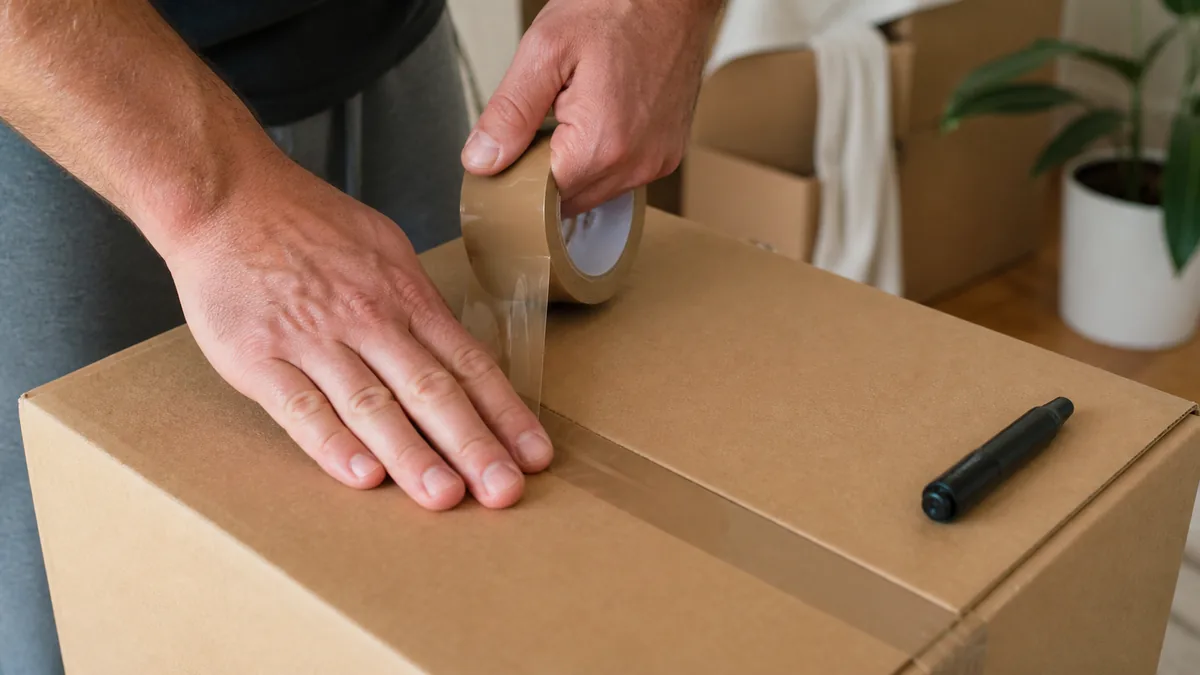
What you need: cardboard boxes in a few sizes, packing paper for wrapping, bubble wrap for anything fragile, packing tape, stretch film, and a marker.
Two things worth knowing. Books go in small boxes — a large box of books is too heavy to carry safely and its bottom gives way. And stretch film holds drawers and doors shut in transit and protects the surface from scratches, which is why it is on the list even though nothing goes inside it.
New boxes are stronger than old ones, and for books and crockery that matters. Old boxes are fine for light, low-value things. We stock twelve sizes and take back whatever you do not use.
For anything breakable, there is a separate method — see packing fragile items.
Change your address and cancel the services
As the day gets close, the last piece is administrative: notify the authorities, your bank and your employer, and move or cancel the utilities — electricity, gas, water, internet, television.
Do it a week ahead rather than on the day. A final meter reading at the old address takes two minutes while you are standing there and is a long argument afterwards.
Frequently asked questions
How many days ahead should I start packing?
Two to three days for a flat, four to five for a house. That avoids the last-day rush, which is where most damage happens.
In what order should I pack the rooms?
Least-used rooms first — storeroom, attic, garage. Leave the kitchen and bathroom until last, because you need them up to the morning of the move.
New boxes or old ones?
New cardboard boxes are stronger and more reliable, particularly for heavy things like books and crockery. Old boxes are fine for lighter, less valuable items.
Can you do the packing for me?
Yes. If you have no time or would rather not, our crew can take on the whole packing with proper protection for everything, and we guarantee what we pack ourselves.
How many boxes will I need?
Roughly 15–20 for a studio, 25–35 for a one-bedroom, 40–55 for a two-bedroom, and 60 upwards for a house. We take back what you do not use.
What should I keep out of the boxes?
A small case with what you need for the first night, and separately your documents, jewellery and laptop — those travel with you, not in the load.

Marko Mišulić
KOMBI-KOMBI has been running since 2013, and in that time several thousand homes and businesses have gone through our vans in Belgrade, across Serbia and around Europe. Everything on this blog comes from what our crews actually meet on the job.