The difference is what you are paying for
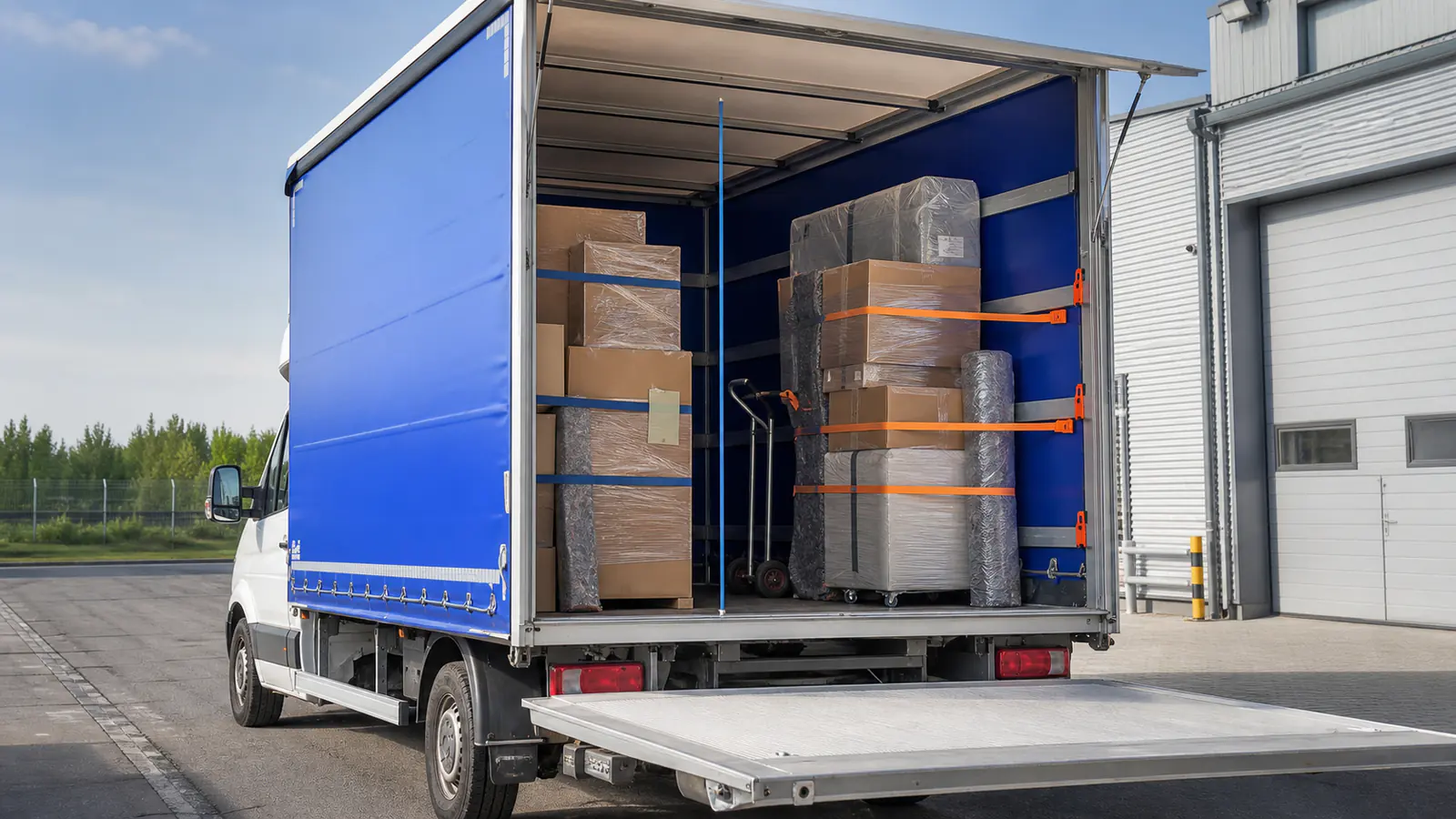
With a whole van you are paying for the vehicle. It travels for you alone, on the date you choose, from your door to your door. Whether you filled it to the roof or halfway, the price is the same.
With a part load you are paying for space. Your things share the vehicle with one or two other consignments going the same way, so the cost of the journey is divided. It is charged by the cubic metre.
Everything else follows from that: a part load is cheaper but slower and less flexible on the date. A whole van costs more but goes when you say.
The line sits around 8 m³
A practical rule from our own runs: below 8 m³ a part load is almost always cheaper; above 10 m³ a whole van starts to pay. Between the two it depends on the route and on how much the date matters to you.
To work out where you are, here is roughly what things take up:
- studio — 5 to 8 m³;
- one-bedroom — 8 to 12 m³;
- two-bedroom — 12 to 25 m³;
- three-bedroom — 25 to 35 m³.
Those figures are furniture and boxes together. If you are moving only personal belongings and leaving the furniture, halve them.
What a part load really means for your dates
This is the part people most often overlook. A part load does not leave when you want it to — it leaves when there is enough freight for that direction.
- to Germany and Austria runs go most often, as a rule monthly and frequently more;
- to Czechia, Poland and Italy, roughly monthly;
- to Spain and Portugal, every two to three months.
So: if you have a fixed move-in date, a part load is a risk. If it makes no difference to you whether your things arrive on the fifteenth or the twenty-fifth, the saving is real and substantial.
Planning a move?
Tell us what needs moving and we will give you a firm price.
When a part load is not a good idea
Three cases where we will tell you to take the whole van even though the volume says otherwise:
- A date that cannot move — a tenancy starting, a handover, a flight. A part load travels when the run goes.
- A piano, large glass or artwork. The insurance is the same either way, but on a part load the goods are handled more often, and every extra handling is a chance to damage something irreplaceable.
- You are not there to receive it. With a whole van the delivery hour is yours; with a part load it falls where it falls in the run.
How the price is actually worked out
For a whole van the price goes by the kilometres driven, at a level that depends on the size of the home. You can see it straight away on the route page or through the cost calculator.
For a part load the price goes by the cubic metre and depends on the direction. That is why a part load always needs a survey: without one we do not know how much space you take, and a guess by eye can be a third out, in either direction.
The survey is free, in person or over a video call. It takes about a quarter of an hour, and after it the price does not move unless the list does.
A practical way to decide
Ask yourself two questions, in this order.
First: do I have a date that cannot move? If yes — whole van, and that is the end of the discussion.
If there is no fixed date, then: how many cubic metres do I really have? Under eight — part load. Over twelve — whole van. In between, ask for both quotes and compare; the difference can be small, in which case convenience wins.
For an exact figure call +381 66 50-40-30-9.
Frequently asked questions
How much cheaper is a part load?
For a consignment up to 12 m³, usually between a third and a half of the whole-van price, depending on the direction. Above 12 m³ the difference disappears, because the space you pay for approaches the price of the vehicle.
How long is the wait for a part load?
To Germany and Austria, as a rule up to a month; to Czechia, Poland and Italy about a month; to Spain and Portugal two to three months. The run leaves when there is enough freight for that direction.
Are my things kept separate from other people's?
Yes. Each consignment is packed and labelled separately and loaded in its own part of the vehicle. The inventory is kept per consignment, so at unloading it is clear what belongs to whom.
How many cubic metres is a one-bedroom flat?
Usually 8 to 12 m³ with furniture and boxes. If you are leaving the furniture and moving only personal belongings, reckon on about half that.
Can I change my mind after the survey?
Yes, until the date is confirmed. After the survey you get both prices — part load and whole van — so you choose on the numbers rather than on a guess.
Is a part load less safe?
The insurance is the same. The difference is that the goods are handled more often, so for a piano, large glass or artwork we still recommend a whole van.

Marko Mišulić
KOMBI-KOMBI has been running since 2013, and in that time several thousand homes and businesses have gone through our vans in Belgrade, across Serbia and around Europe. Everything on this blog comes from what our crews actually meet on the job.