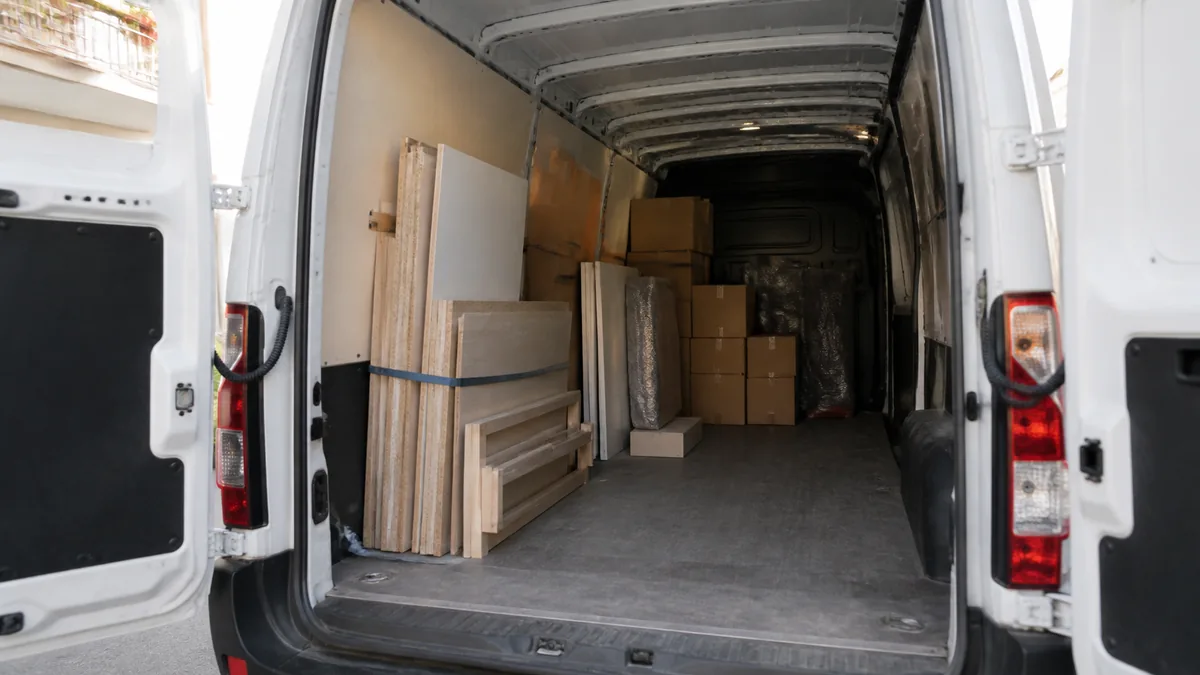
How much fits in one van
"How many vans do I need?" is a question we are asked every day. The short answer for a three-bedroom flat: one truck, or two to three trips with a van. The longer answer depends on how much you actually own.
A standard removal van has a load space of about 10 to 12 cubic metres. In practice that is roughly one bedroom — bed, mattress, a wardrobe in pieces, a chest of drawers — plus 15 to 20 boxes. A studio fits in one trip; a one-bedroom flat in one full trip or one and a half.
A truck carries 20 to 30 cubic metres, two to three times the van. For larger flats that is where the arithmetic changes: everything goes in one trip, there is no driving back and forth, and the total time — and therefore the price — is often lower than three trips with a van.
A three-bedroom flat in practice
An average three-bedroom flat of 65 to 80 m² looks like this with our customers: a double bed and one or two more beds, a corner sofa, a dining table and chairs, two or three wardrobes, kitchen units, a washing machine, a fridge, a cooker, a TV unit and 40 to 60 boxes.
That comes to about 25 cubic metres, and up to 35 for a fuller flat — the same bracket the price list gives a three-bedroom. So: one truck in a single trip, or a van in two to three trips if the new address is close by. If the flat also has a cellar, a garage or a balcony full of things, add another half a trip — and those are exactly the spaces people leave out when they estimate, which is covered in what people forget when they move.
Planning a move?
Tell us what needs moving and we will give you a firm price.
Van or truck?
The rule we use when quoting: if the move fits in one van trip, the van is cheaper. If it needs three or more trips, the truck almost always wins — fewer hours of crew time and one drive instead of three. For two trips it depends on distance: within the same neighbourhood the van does well, across the city the truck.
There is one exception. In the narrow streets of the old centre, and in neighbourhoods where a truck simply cannot get close, we use a van regardless of the volume and put a larger crew on it so the trips go faster.
How to estimate it yourself
Walk through the flat with a piece of paper and list the large pieces — anything that will not go in a box. Then estimate the boxes:
- 10 to 15 boxes per room
- 10 to 12 for the kitchen
- One box per half metre of hanging rail in a wardrobe
Send us that list — by phone, or as photographs on Viber — and you get a definite recommendation for the vehicle and a fixed price. The survey is free, and the calculator gives you a rough figure in the meantime.
If it turns out there is less than you thought, so much the better — you pay for the smaller trip. And if a van is going to be half empty, there is part-load transport, where you pay only for the space you take up.
Frequently asked questions
Does a three-bedroom flat fit in one van?
No. A three-bedroom flat is usually around 25 cubic metres of belongings, up to 35 if it is well filled, while a van carries 10 to 12. It needs two to three van trips, or one truck in a single trip.
What is cheaper for a three-bedroom flat, a van or a truck?
A truck, almost always: everything goes in one trip, so the crew works fewer hours. A van only wins when the new address is very close, or when a truck cannot physically get to the building.
How many boxes does a three-bedroom flat need?
Forty to sixty on average. Reckon on 10 to 15 per room and 10 to 12 for the kitchen, plus one box per half metre of hanging rail in the wardrobes.
How do I know exactly which vehicle I need?
Send us a list of the large items and a rough box count, by phone or as photographs — we will tell you the vehicle, the crew size and a fixed price, free of charge. Call 066/50-40-30-9.
What if my things do not fill a van?
Then you should not be paying for a whole one. Part-load transport charges only for the space you actually occupy, which is usually between a third and a half of the price of a dedicated van.

Marko Mišulić
KOMBI-KOMBI has been running since 2013, and in that time several thousand homes and businesses have gone through our vans in Belgrade, across Serbia and around Europe. Everything on this blog comes from what our crews actually meet on the job.