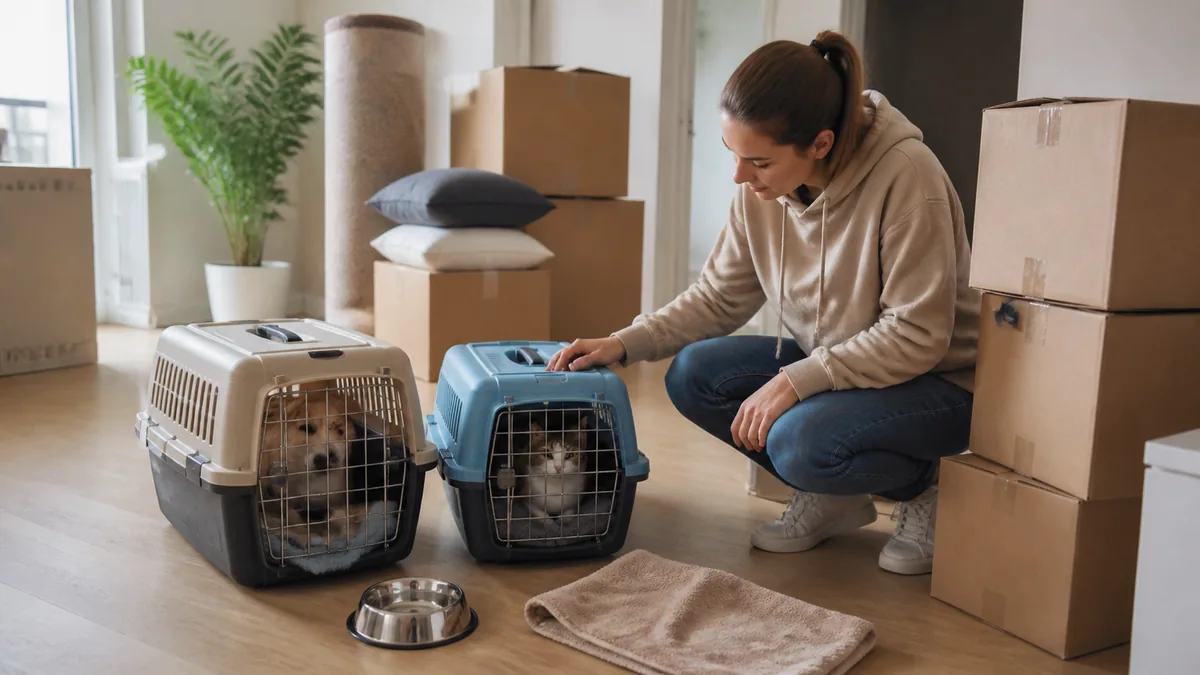
Start two to three weeks before
A move is stressful for animals for a reason people underestimate: they get all of the disruption and none of the explanation. New smells, rooms emptying one by one, the routine breaking down — and no way to know it is temporary.
Begin preparing two to three weeks ahead. Four things, in this order:
- See the vet. Check the vaccinations are current, get copies of the records, and ask about anxiety if your animal is prone to it. If you are moving to another city, ask for a recommendation there.
- Make the carrier normal. Most pets fear the carrier because it only ever appears before a vet visit. Leave it open in the room where they spend time, put a familiar blanket or toy inside, and give a treat when they go in. The aim is for it to become a safe place rather than a signal.
- Keep the routine. Same feeding times, same walks, same play, right through the packing. Routine is what animals use for reassurance, and it is the one thing you can hold steady while everything else changes.
- Check the identification. Update the tag with the new address and phone number. If your pet is not microchipped, this is the moment — the risk of escape is higher during a move than at any other time, and a chip is the difference between a scare and a loss.
Dogs
Dogs are attached to their people as much as to the place, which is why most adapt reasonably quickly — but the day itself can be hard.
Before the move, take the dog to see the new place if you can. Let them explore, smell the yard or the entrance, and be somewhere that is not entirely new on the day. Walk the new neighbourhood and find the nearest park while you are at it.
On the day, remember that dogs read you. If you are tense and rushing, your dog will be tense too. If a friend or relative can take them for the loading and the drive, that is by far the best arrangement. If not, put them in the room that is packed last, with food, water, toys and their blanket.
Cats
Cats are territorial, and for a cat the home is the territory. A move is not a change of scenery, it is the loss of the whole thing — which is why cats generally take it harder than dogs and need more patience.
A safe room. A few days before the move, set one room up with everything the cat needs: food and water bowls, the litter tray, the scratching post, favourite toys and a blanket that smells familiar. When the packing and noise start, that is where the cat stays.
Pheromones. Synthetic cat pheromone diffusers help noticeably with stress. Plug one in in the safe room a few days ahead, and again in the new home before you let the cat out to explore.
Introduce the new home gradually. Do not open the whole flat at once. One room first, with all their things in it, and then more rooms over several days as they settle. For a nervous cat this matters a great deal.
Planning a move?
Tell us what needs moving and we will give you a firm price.
The journey itself
The day of the move is the critical point, and how the transport is arranged makes most of the difference.
- A carrier is not optional, whether you are going by van or by car — for the animal's safety and everyone else's. It should be big enough to stand up, turn around and lie down in.
- Temperature and ventilation. Never leave an animal in a parked car in summer; the temperature inside becomes dangerous within minutes. Make sure there is airflow, and use the air conditioning if you need to.
- Breaks every two to three hours on a long drive. A dog needs a short walk and water. A cat stays in the carrier — offer water and check on them, but do not open it in an unfamiliar place.
- Never in the van with the furniture. Your pet travels separately, ideally in your own car where you control the conditions.

That split is the practical argument for having someone else do the move: while our crew handles the packing, loading, transport and unloading, you have nothing to do except look after the animal. We also handle pet transport as a service of its own.
Settling in
Arriving is not the end of it — in some ways it is the start.
- Put the familiar things out first. The bed, the toys, the bowls. And do not wash the blankets and bedding before the move: those familiar smells are exactly what provides the reassurance.
- Keep the same schedule. If the dog ate at eight in the morning and six in the evening, keep that. The routine is the anchor.
- Supervise the exploring. Check every window and door closes properly, look for gaps a cat could disappear into, and watch the balconies. Also check for anything the previous occupants left behind — toxic plants, cleaning chemicals under the sink.
- Expect it to take weeks, not days. Dogs usually settle in two to four weeks; cats can need four to eight. Reduced appetite, hiding, extra barking or meowing, and accidents outside the litter tray are all normal and temporary. If it is still going on after a month, see a vet.

If you are moving to another country, the animal needs its own paperwork and the timings are long — the chip, the rabies vaccination and the antibody test run to at least four months in total. That is set out in moving a pet to the EU.
Frequently asked questions
How do I prepare a dog or cat for a move?
Start a few weeks ahead. Make the carrier a normal, safe object rather than a vet signal, keep the feeding and walking routine unchanged through the packing, and let them get used to the boxes gradually. Check the vaccinations are current with the vet and get copies of the records.
Should the pet be at home on moving day?
Preferably not. The best arrangement is a friend, a relative or a boarding place for the day — the noise, the open doors and the furniture going through the hallway cause real stress and are the most common way a pet escapes. If that is not possible, keep them shut in one room with everything they need.
How long does it take a pet to settle into a new home?
Dogs usually two to four weeks, cats four to eight. Some adapt in days. Keep the familiar routine, put out their old toys and blankets unwashed, and be patient. If the changed behaviour is still there after a month, see a vet.
Can my pet travel in the removal van?
No. Pets travel separately, in a carrier, ideally in your own car where you control the temperature and ventilation. On a long drive, stop every two to three hours — a dog for a short walk and water, a cat for water and a check without opening the carrier.
What helps most with a cat specifically?
A safe room, set up a few days before the move with the litter tray, bowls, scratching post and familiar blankets, and a pheromone diffuser. Then introduce the new home one room at a time over several days rather than all at once. Cats lose their whole territory in a move, which is why they take it harder than dogs.

Marko Mišulić
KOMBI-KOMBI has been running since 2013, and in that time several thousand homes and businesses have gone through our vans in Belgrade, across Serbia and around Europe. Everything on this blog comes from what our crews actually meet on the job.